Life After Death: An Inquisition into Different Beliefs
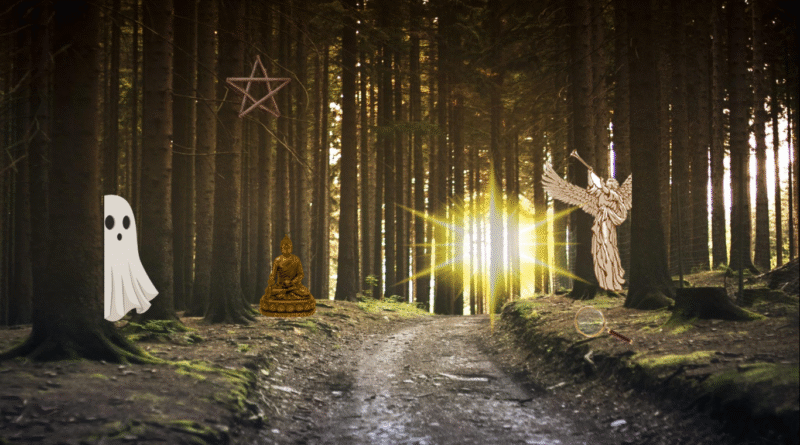
Are ghosts and gods the same thing? Spiritual elements like those and a vague awareness of what death brings is a binding factor between religion, spirituality, and belief in the paranormal. Yet, the validity of these beliefs is often debated in society. One of Blake’s biggest goals is to create a safe and accepting environment for people of any belief. This also means that Blake has an expansive representation of different beliefs, and we’ll be covering the basics of several of them in this article to figure out what exactly the difference is and what makes a belief valid. Just in time for Halloween.
Paranormal:
Speaking of which, everyone has heard of ghost stories murmured in soft whispers around the campfire, speculating about the shadows that gather in the corners and random noises in the woods at night. But what if they were true?
Historically, spiritual elements have existed in many cultures for thousands of years. Specifically, ghost stories and the belief in the paranormal originated in the first century A.D. with a letter written by Roman author and statesman Pliny the Younger. Since then, they have skyrocketed in popularity and profit, with many famous books like The Shining by Stephen King and local legends becoming a source of income for artists, writers, and other professions. Despite the fact that they originated in a similar fashion, believing in the paranormal is often ridiculed and seen as childish or invalid compared to believing in religion. But why?
We asked beloved physics teacher, Mr. Cornell about the role that science plays in paranormal experiences, to which he responded that “science and paranormal beliefs can coexist in places where they best serve us”. Being a man of science, Mr. Cornell doubts that any real paranormal experience has occurred, and remains firm in his belief that everything can be explained by science. Instead, he discusses how he believes that storytelling is a grounding feature of many religions, and that “the paranormal is a tool for telling those stories.” Mr. Cornell highlights the important lessons that can be learned from these stories regardless of the scientific explanation.
With this perspective, Mr. Cornell categorizes the paranormal as more of a method for storytelling than a genuine belief system. This is an interesting take, as many people view belief in the paranormal and belief in science as separate entities when, in practice, they are not necessarily mutually exclusive. While lots of scientific phenomena can be the cause of paranormal experiences, there are still occurrences that people just can’t or won’t explain scientifically. Perhaps a mysterious light in the woods, or a whisper under the doorframe.
Even so, some people are just in it for the thrill of it. After all, there is something to be said about humanity’s denial of death. The idea of a lingering spirit is unnerving to most people, they don’t like the thought of their tether to reality being severed, or imagining what happens when the world ends. Interestingly enough, most ancient mythology from cultures all over the world includes some sort of catastrophic event in which humanity is wiped out, though people believe this to varying degrees. Even though we’ve been around it for so long, humanity is still afraid to confront the enigma of death. The space between consciousness of life and the awareness of death is where stories usually featuring the paranormal are born. That odd transition between livelihood gifted by some extraordinary stroke of luck from the universe and the inevitable end to it, taken by that same universe. That fear is so strong, so holistic that people make up stories just to avoid it, whether consciously or not, even if the stories are offputting or otherworldly.
There’s something to be said about the part that the denial of death plays in the formation of beliefs. The idea of a soul, a concept which holds all of one’s nonphysical being, simply ceasing to exist creates a gut-wrenching fear in most of humanity. But the idea of an immortal tether linking that soul to a distant existence on earth also strikes fear into our hearts. Ghost stories are as frightening as they are because they deal in the enigmatic nature of death. This fear is what relates it to other belief systems like religion or spirituality.
Paganism (Kiri):
While its connection to the paranormal is often debated, paganism has been used in the past as an umbrella term to categorize any spiritual or religious belief independent of major religions. It also tends to have nature-based practices and beliefs. While most are skeptical at best, the communities within paganism remain tight-knit and steadfast in their beliefs.
Throughout history, there has been a certain demonization of paganism, primarily by Christians, that has led it to be associated with ‘demonic’ practices like rituals, spells, and the occult. The lack of theological uniformity wasn’t widely understood, more so feared in a way that created a common enemy in times of religious strife.
An anonymous student at Blake agreed to be interviewed on the subject, revealing that to her, practicing paganism wasn’t a matter of rituals and runes. It was simply collecting things like rocks and leaves in order to keep a piece of memory with her. She revealed that it provided her with a lot of clarity, helping her “deal with a lot of anxiety”, or even just “having something to talk to when it’s not necessarily something you’d talk to people about”.
This student’s experience with paganism highlights its founding principles, and how it is, at its core, an abstract belief. Rather than one omnipotent celestial being, paganism focuses on appreciation and respect for nature, learning to speak a language long forgotten by mortal tongue and instead whispered in the breeze or written in the grooves of the tree bark. The focus remains on the experiences and emotional presences of those who practice it.
Spirituality:
Emotional presence and worldly experience is also an important element in spirituality. Spirituality is the general belief that there is a higher being that guides you through the world. The higher being isn’t tied to any specific religion, allowing these practices to be flexible to the personal beliefs of each person. But people who follow this way of belief allow that higher being they believe in to guide them through their decisions and aspects of life. Even if things don’t go as planned, or things go wrong, there is a reason beyond comprehension for why that occurred.
This way of belief is tied very closely to yoga and its principles. There are two main principles of yoga, the Yamas and Niyama. With each one having five guidelines helping people work with them. Yamas are how you treat others and Niyamas are how you treat yourself.
The main five guidelines for the Yamas are Ahimsa, Satya, Asteya, Brahmacharya, and Aparigraha. Ahimsa is nonviolence toward others through your actions and thoughts of others. Satya is truthfulness through your words and actions towards others. Asteya is not stealing what isn’t yours, which includes wasting time and draining the energy of others along with physical things and thoughts. Brahmacharya is knowing how to use your energy in moderation. Aparigraha is the rejection of greed and appreciation of what you already have.
The main five Niyamas are Saucha, Santosha, Tapas, Svadhyaya, and Ishvara Pranidhana. Saucha is the cleanliness of your body, mind and surroundings. Santosha is finding contentment with what you have and finding joy in the present. Tapas is self-discipline and persevering when things get difficult. Svadhyaya is learning about yourself in many different ways. And Ishvara Pranidhana is trusting in something greater than you and understanding that not everything is in your control.
Chakras are another factor of spirituality that are important to those who follow it. There are seven places from the base of the spine all the way up to the top of your head in a straight line. Their names are Root, Sacral, Solar Plexus, Heart, Throat, Third Eye, and Crown going from bottom to top. Each chakra has its own respective color of the rainbow, mantra, seed sound, and element. There are also certain things associated with each one, like compassion for the Heart chakra, or intuition for the Third Eye. It is said by those who follow them that once all the chakras are aligned, you would have a better connection with that higher power you personally believe in.
As said in the beginning of this section, those who believe in this type of spirituality or anything similar practice it through yoga. The specific poses, referred to as Asanas, and pose sequences help with clearing the mind, building strength, enhancing flexibility, and other things that people feel would allow them to grow and evolve as an individual, starting through the body. For them, yoga helps them understand what was previously unknown or confusing to them previously. If full understanding of the reason for something in inaccessible for whatever reason, they are able to accept that fact and move forward knowing a higher power will help guide them to understanding, even if it comes far into the future When asked about her thoughts on how yoga is used to express these beliefs, Christine Di Monte, a PE teacher at Blake for the yoga class, states that it’s “a way to live.”
Religion:
Speaking of ways to live, most people are familiar, or at least aware of the main five religions; Christianity, Islam, Judaism, Buddhism, and Hinduism.
Christianity is an Abrahamic monotheistic religion. Followers of Christianity follow the teachings of Jesus and the word of God, which are written in the Bible and its many books within the Old and New Testaments. Islam is another Abrahamic monotheistic religion. Followers, called Muslims, live by their book of faith called the Quran and the teachings of Muhammad. Judaism is not only an Abrahamic monotheistic religion, but also an ethnic religion. This religion comprises the spiritual and cultural traditions of the Jewish people. Judaism is also considered to be one of the earliest monotheistic religions. Buddhism is a religion and philosophy that is based on the teachings of the Buddha. This is the only one of the five major religions that doesn’t believe in any higher being. Hinduism is a polytheistic religion that adheres to Dharma, a cosmic order maintained by those who follow it. It is also considered to be one of the oldest surviving religions today.
Though it is hard to say for certain why these organised religions came to be, it can be theorized that they sprung up because of events that occurred during a specific time in a specific place. Another factor that allowed these religions to develop as widely as they did was the human need for understanding. Many people turn to religion to help explain things that they don’t fully comprehend. Organized religion also brings structure into the lives of its followers. This happens due to various rituals, like prayer or attending a religious ceremony, done by the followers, becoming a constant thing in their lives that becomes much needed when life gets inconsistent or complicated. These rituals creates a community that followers can be a part of by simply following their preferred religion. Finally, many may be drawn to an organized religion because each of these factors come together to provide comfort to those who devote parts of their lives to them. Bringing security to those people in whatever form it decides to take.
So what does it all mean? Blake’s community represents a wide variety of belief systems, all with their own different and unique origins. Everyone’s experience with their belief is different, and should be considered with an open mind. Some of the similarities observed between the different belief systems were that they all seem to rely partially on oral traditions and storytelling, a particularly interesting element considering it’s impossible to prove or disprove. All belief systems began with a story, whether it was an experience someone claims to have had millions of years ago or a hope for life after death that has resonated throughout humanity. The fact that this element is so consistent and yet cannot be authentically verified reflects an important perspective that is often overlooked; no belief should be seen as invalid just because of a ‘lack of proof’ or because its primary source information cannot be proven to exist. Throughout the world, there are people with identically committed beliefs in religion, spirituality, and the paranormal, regardless of how much “proof” any of them have. It can be concluded from this article that that commitment is what makes a belief valid.