
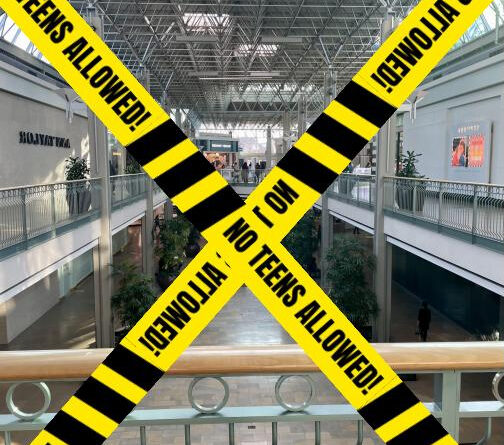
Mall Restrictions Are Undermining Critical “Teen Spaces”
When Westfield Malls announced restrictions earlier this year, young teens saw their spaces put on trial. The Consumer News and Business Channel (CNBC) affirms that “many of the public and private third spaces left, including some malls, limit teens’ access,” with the National Harbour’s recent restrictions being yet another local example of limited social options for Montgomery County teens.
Westfield Montgomery Mall and Westfield Wheaton followed Columbia Mall’s footsteps by enabling a restriction of teens under the age of 18 to be supervised by an adult over the age of 21 after 3 p.m., Monday through Friday. With these strict regulations, questions surrounding new alternatives and strong opinions rose indefinitely.
The Blake Beat spoke with MCPS high school students about how these mall restrictions have impacted their lives. Blake Senior Madelin Almaraz believes that mall restrictions “have definitely made things complicated.”
Madelin said that “If I want to go shopping or hang out with friends, I have to think more about whether an adult can come with me or give me a ride.” This is an important note because finding a parent or guardian on weekdays creates an unnecessary hassle for busy families. As Madelin stated, “It can also make plans harder to organize because not everyone’s parents are available.”
For many teenagers, malls were a critical teen space that encapsulated both affordability and accessibility. With local malls enforcing strict adult supervision after 3 p.m. on weekdays, students are finding themselves with limited options right at the end of the school day.
While authorities aim to “end” fights and juvenile delinquency, several students feel the regulations act as a blanket punishment rather than a targeted solution.
A Senior at Albert Einstein High School, Ezra MacDonald, stated, “I think it is ridiculous because why should I be subject to prejudice just because other teens are doing bad or illegal things.” Ezra pointed out that the restrictions overlook innocent students by having their voices become overshadowed by the people causing the commotion in these situations.
Blake senior Brielyn Bunting-Graden echoed this frustration, explaining a direct parallel between the new mall curfews and restrictions faced on school grounds.
Brielyn also expressed that “restrictions aren’t fair because not everyone who’s a minor is a criminal.” Brielyn continued to say that, “Similar to Blake, where we are banned from eating outside for lunch because of an incident that involved outsiders… mall management needs to take effective measures to protect everyone, not just target one group based on skewed incidents.”
However, not all local students view the policy as an unfair response. Wheaton High School senior Julian Ramirez believes the supervision rule is a practical move toward maintaining public safety.
Julian feels that “ this is a good rule. It helps with teenagers who are trying to cause danger and ultimately keeps everyone and the environment safe.” Julian noted that his own routine remains largely unaffected, as he typically visits the mall alongside an older sibling.
Ultimately, the overarching consensus among students opposing the mall curfew is a signal for mall management to reconsider their strategy. Instead of complete restriction, students suggest that malls invest in better safety protocol and targeted punishments against the specific individuals who hinder the safety of others.
As Madelin emphasized, “Teenagers also need places where they can safely hang out and socialize.”