Haiti to Blake: What I’ve Learned about Schooling Differences
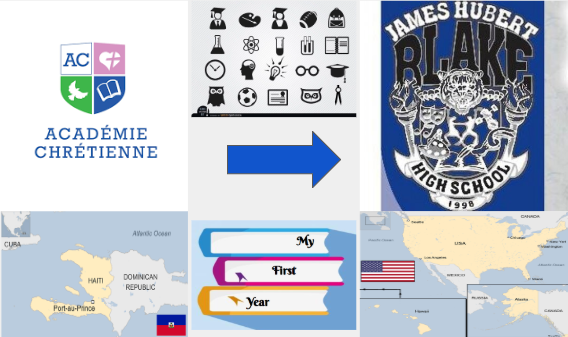
My name is Lynn Asha Stherly Eugene. I’m 14 years old, finishing my freshman year at Blake, which is also my first year at an American school. I lived in Haiti until late 2025. I have enjoyed Blake because, among other things, it is very different from my school in Haiti. Here, I’ll lay out the biggest academic, social, and structural differences between my school in Haiti and Blake High School.
Class Activities/ Socialization
The first thing I noticed here is that Blake (and American school in general) is more open socially–and based on social interactions. You meet with different people who speak many languages and interact with different cultures, all celebrated and recognized. You’re encouraged to join extracurricular activities, and many subjects are taught to prepare you for college. We’re often put into groups to work together and get to know each other, with emphasis on building community while learning. Kids here make friends in school and with those who participate in the same activities.
In Haiti, independent academics were by far the main focus of school. There was rarely group work, and most of our instruction came from teachers lecturing or putting notes on the board for us to copy and retain.
At Blake, we have dances and social activities and sports. Schools in Haiti are focused on education, and they don’t include those other events. In Haiti, students can participate in sports and groups/clubs in their community, but they typically aren’t connected to the schools at all.
School Structure
Here in the US, most kids go to private schools, progressing through three schools as they grow up (Elementary, Middle, and High). In Haiti (where 80-90% of the schools are private), the schools are divided into two sections: the fundamental (grades 1-6) and the secondary (basically grades 7 – 12).
Testing/Exams
Promotion to the next grade in Haiti is done by passing content exams, and a passing score is required for promotion. There are two government-created exams to take on the 9th and before graduation. Basically, you’re held back academically until you pass the required tests called (the baccalauréat (bac) exam, which grants access to university). Hours of studying and preparation are required for success to progress through grade levels in Haiti. For the exams, students are expected to retain information from the whole school year; that’s something that definitely feels different about school in the USA. Here at Blake, there are no exams, and promotion to the next grade level happens regardless of your academic performance (with the exception of courses that require prerequisites, like world languages). Usually here, in math class for instance, we are given quizzes and tests during units, but then we’re onto the next concept and we forget the information that’s no longer needed.
Meals
At Blake there is a cafeteria with food free available to all students that provides students with different meals, changing based on the day of the week. In my school there is a cafeteria where only students who pay monthly fees get meals provided by the school. The food provided by schools in Haiti was also much more nutritious, with substantial servings of fruits and vegetables.
Teachers/Teaching Styles
I like the teachers at Blake, definitely my 9th grade teachers, because when I was having a hard time, they supported and understood me. Even when I was still struggling, I felt supported. At Blake, I know now that I have people who are here if needed: my teachers,my counselors and a few other trusted adults at school. Teachers in Haiti focused solely on my academics; they were much less likely to take time for personal and emotional connections and conversations. They were more strict and harsh with rules, where teachers here are understanding of each student and their needs.
Elective Classes/Student Choice
Here at Blake we have the choice of choosing classes that we want: Sports & Athletics, Performing & Visual Arts, Academic Clubs, Student Leadership, Publications & Media and Community Service. Starting early in high school, students are taught that they can control their education. Students don’t really get the opportunity to choose their studies until after high school in Haiti. The schedule is set for all students, focusing on academic subjects like writing, math, science, and history. There weren’t many upper-level classes filled with much creativity, as opposed to all the art, music, etc. classes that are available at Blake.