Keeping Things F.A.I.R. in our Community
Across the country, many immigrants spent 2025 dealing with heightened anxiety and fear as a result of the current administration’s Immigration policies and procedures. This impact has been felt by students throughout MCPS, where we celebrate our rich diversity and representation of cultures.
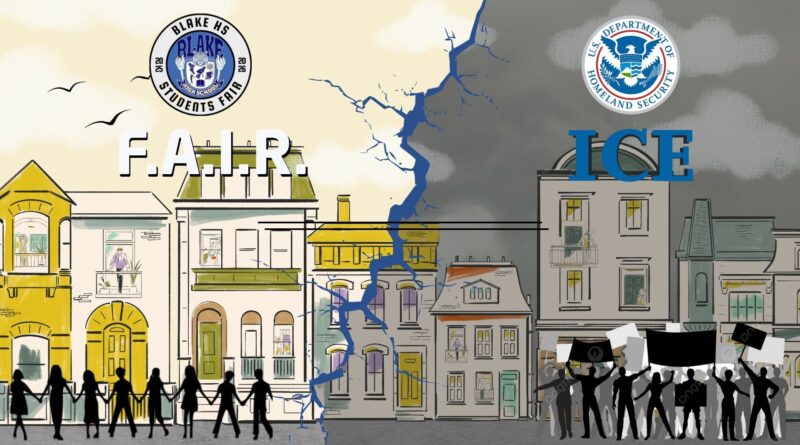
Here at James Hubert Blake High School, students recognized a growing need to protect and support our community to defend against ICE raids, detentions, and deportations. This stems from the support of EML teacher Ms. Kember Kane (the sponsor of the For Asylum and Immigration Reform (F.A.I.R.) club), helping address these issues within our community while providing support for students who are experiencing them.
The student-organized F.A.I.R. club works in educating the community about immigrants’ rights and available resources. By informing students and families, the club empowers individuals to advocate for themselves, support one another, and respond more confidently to encounters with immigration enforcement.
The Blake Beat had the opportunity to sit down with sponsor Ms.Kane and club member Wanda Chaves about the F.A.I.R. club.
Questions – Ms. Kane (F.A.I.R. Club Sponsor)
- Why was this club created?
The interesting thing about Students F. A. I. R. is that it did not start at Blake but at another high school in Montgomery County in response to threats of deportation of MCPS students and families. Students decided to stand up and speak out against the worrisome targeting of immigrant families in our community. Blake students believe there is a need for our community to be defended against ICE raids, detentions, and deportations.
- What main goals do you hope students achieve?
I hope that the students are able to reach the goals they are developing for themselves. In this group, the adult sponsor does not guide the group. F. A. I. R. is a student-created, student-led organization. They are currently reaching their goals of educating students about their rights as immigrants by sharing “Know Your Rights” training with Blake students. Students are learning about what kinds of plans families should have in place before an ICE encounter, what to do if they are ever approached by ICE, and how they can advocate for safety in our communities.
3. What challenges has the club faced in addressing immigration and ICE-related topics?
This is an interesting question. I would say that one challenge is the “Know Your Rights” training is the number one priority. Our students can’t be safe if they don’t know the rules and laws that protect them, so this information is shared at pretty much every meeting. This makes it hard to know which Blake students know about immigrant rights and which ones don’t. Maybe we could create a survey? I’ll ask the group what they think.
4. How do you ensure the information is factual and unbiased?
The “Know Your Rights” training materials have been vetted by reliable sources like the Office of Montgomery County Councilmember Kristin Mink and other local and national immigrant support groups and immigrant lawyers.
5. What kind of activities, discussions, or events does the club organize to raise awareness?
So, as I have mentioned, Blake Students F. A. I. R. has student-led meetings that share “Know Your Rights” training and allow students to fellowship together and ask questions of the student leaders. Moving forward, we are planning to include Students F. A. I. R. club members in English Language Development Family Night events. The students are interested in welcoming, supporting, and informing the Blake community members about how MCPS works and what rights, resources, and legal protections they have here in Montgomery County, Maryland.
6. How do you define “impact of ice” on families, communities, or society as a whole?
I am against any person or organization that creates fear in children and families. Especially the kind of fear that we are seeing in our schools and neighborhoods now. Young children are witnessing the aggressive and sometimes violent behavior of masked men taking people away from their families without any explanation. In my experience over more than 50 years in America, these kinds of scenes were frightening as I watched them on television, happening in other countries, and in movies. The fact that we are in a place and time where men, women, or children can be grabbed anytime, anywhere, feels deeply dystopian to me. The fact that this is sanctioned by the government makes me ask, “Is this really happening?!”
7. Do you think awareness alone is enough to create change? Why or why not?
Awareness alone is not enough, but it is a start. Once people who care are aware of the scope of the problem and understand the source or causes of the problem, they can think together and work together to reverse course.
8. What emotions or experiences stand out to you when learning about ICE and immigration enforcement?
I see shock and fear morphing into determination. What we are witnessing with ICE detentions is shocking and scary. It is messy and wrong. The vast majority of these detentions are not violent criminals, they are people who have administrative or paperwork violations and expirations – not real crimes! Our community is becoming more and more determined to protect and defend our neighbors. We are taking action to share information about the rules, laws, and protections that citizens and immigrants still have a right to.
9. In your opinion, what are some of the biggest misconceptions people have about ICE?
The biggest misconception people have about ICE is that if someone is approached by ICE, they must answer their questions. I learned through the “Know Your Rights” training that “Silence is golden,” and you should not say anything to the agents.
10. What kind of change do you hope your club can make at school/community?
I hope that Blake Students F. A. I. R. can continue to build a community that cares about each other, listens to each other, and learns from each other. It doesn’t matter where you are from; we are all here now, and we should stand together for peace where we live.
Questions – Wanda Chaves (11th Grade Club Member)
- Why did you join the club?
I joined the F.A.I.R. club because I feel like it’s important to show where I stand on the issue of what’s happening towards our community, and that I do believe it is NOT okay or right. I want to help spread awareness in any way I can because I think it’s great to have these platforms or resources in our school and county.
- What does “bringing awareness” mean to you?
Bringing awareness to me means making posters, posting GoFundMe pages for people in our school or school district, helping others, educating others, and bringing attention to what to do and what to keep in mind. The F.A.I.R. club does a good job of these things.
- How has being in this club changed your perspective on immigration or law enforcement?
Being in the club added to my perspective. We really do need to support anyone we can in our school who is affected by this, because it is heartbreaking that students have an added worry on their plate. It makes me concerned for how our system is working and using itself. It makes me sad about how much harder it is for immigration than it already was.
- What have been some of the most impactful activities or discussions you’ve had in this club?
The most impactful thing the club has done is posting the donation links for affected families in need. We are helping raise so much money that is greatly appreciated by those who need it in our community.
- How do you think young people can play a role in shaping how immigration issues are handled?
I believe more Blake students should get into law enforcement or our government to help our country and state, while being a voice for our families and community. For them to know that it’s okay to not be afraid to show where they stand.
Through the voices of both its sponsor and student members, the F.A.I.R. club is a reminder that demonstrates the impact a student-organized effort can have beyond the classroom. By educating peers, supporting affected families, and encouraging informed action, the club stands as a reminder that advocacy can begin within schools. F.A.I.R. not only responds to the current challenges but also shapes a more informed and compassionate community.